 Nox-Lumen Mfg
Graft (cross-session)
What Graft is
Graft lets parallel Agent sessions reference one another’s results—like Git graft, stitching independent histories together.
Cross-session example: full V-Model chain
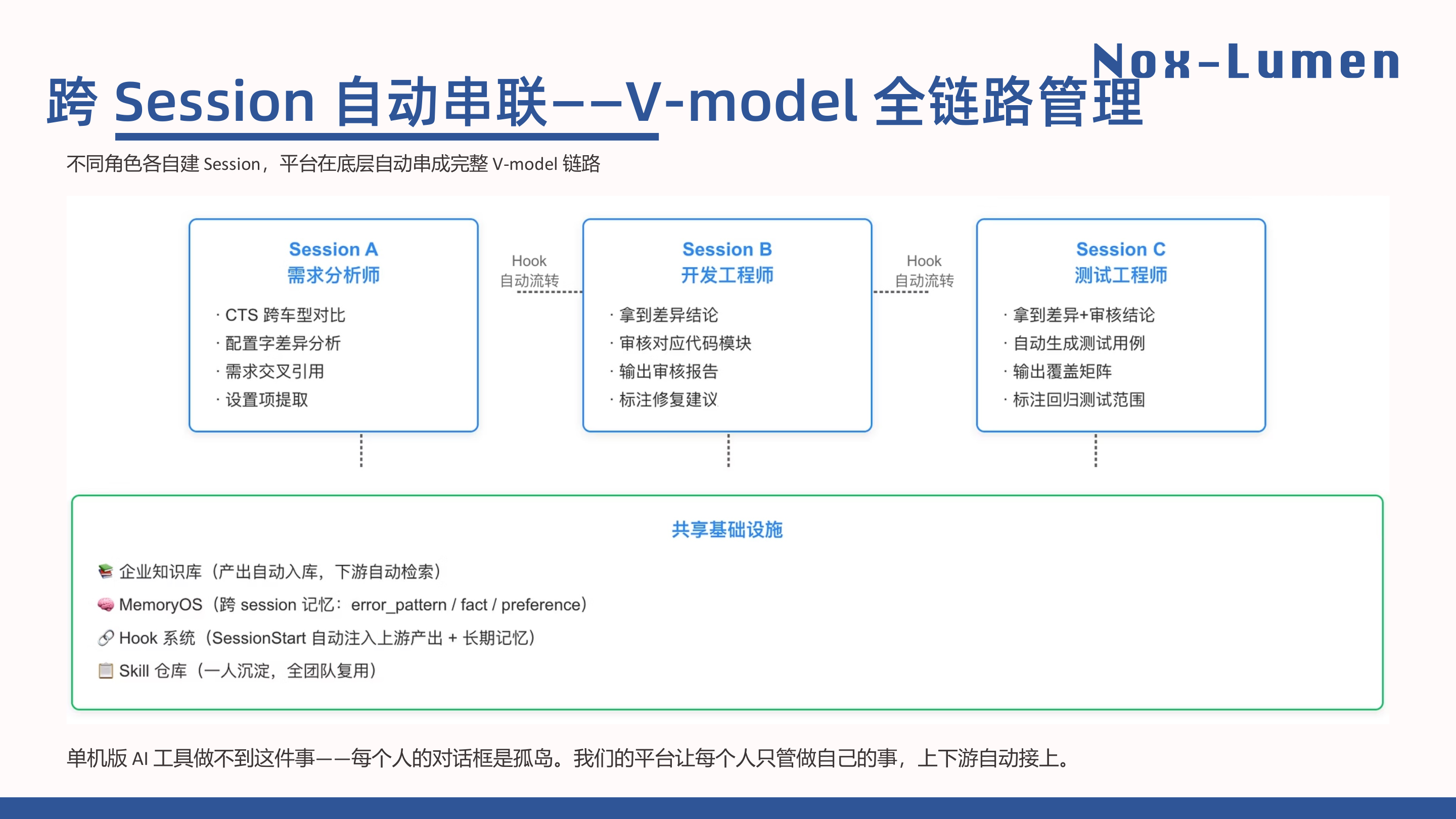
Each role runs its own session; the platform chains a full V-Model path via Hooks + shared infrastructure:
- Session A (requirements analyst): cross-vehicle CTS comparison → configuration delta analysis → requirement cross-references → option extraction
- Hook handoff →
- Session B (development engineer): consumes deltas → reviews code modules → review report → fix notes
- Hook handoff →
- Session C (test engineer): consumes deltas + review → auto-generates tests → coverage matrix → regression scope
Shared infrastructure:
- Enterprise knowledge base (artifacts indexed automatically; downstream retrieval)
- MemoryOS (cross-session memory:
error_pattern/fact/preference) - Hook system (
SessionStartinjects upstream outputs + long-term memory) - Skill repository (one person captures; whole team reuses)
Standalone desktop AI cannot do this—every chat is an island. The platform lets each person focus on their step while upstream/downstream connects automatically.
Typical scenarios
| Scenario | Description |
|---|---|
| Parallel agent merge | Session A finishes cooling-system analysis; Session B needs A’s conclusions for vehicle-level assessment |
| Incremental iteration | Last week’s session did baseline analysis; this week’s session deepens on top |
| Multi-user collaboration | Under the same tenant, user A’s session outputs are referenced by user B’s session (with authorization) |
Security boundary
Users must explicitly enable via
/graft; the Agent cannot decide cross-session access on its own.
This ensures:
- By default the Agent does not know other sessions exist—no random browsing
- Cross-session access reflects explicit user intent
- Every cross-session action is auditable
Design notes
Graft ships as a builtin skill under skills/builtin/graft/:
- Activation (Skill): controls whether the Agent knows cross-session capability exists
- Capability (Tool):
session_idparameter, permission checks, cross-session search
Without /graft → SKILL.md is not injected → the Agent does not know the session_id parameter exists → no misuse.
Usage example
After the command:
Real execution example
Below is a real session flow—customer demo executive summary DEMO-E used 4-worker parallel Graft to read outputs from prior sessions DEMO-A/B/C/D and produce a demo landing page.
⚡ Parallel execution · 4 workers: read findings from four upstream sessions at once
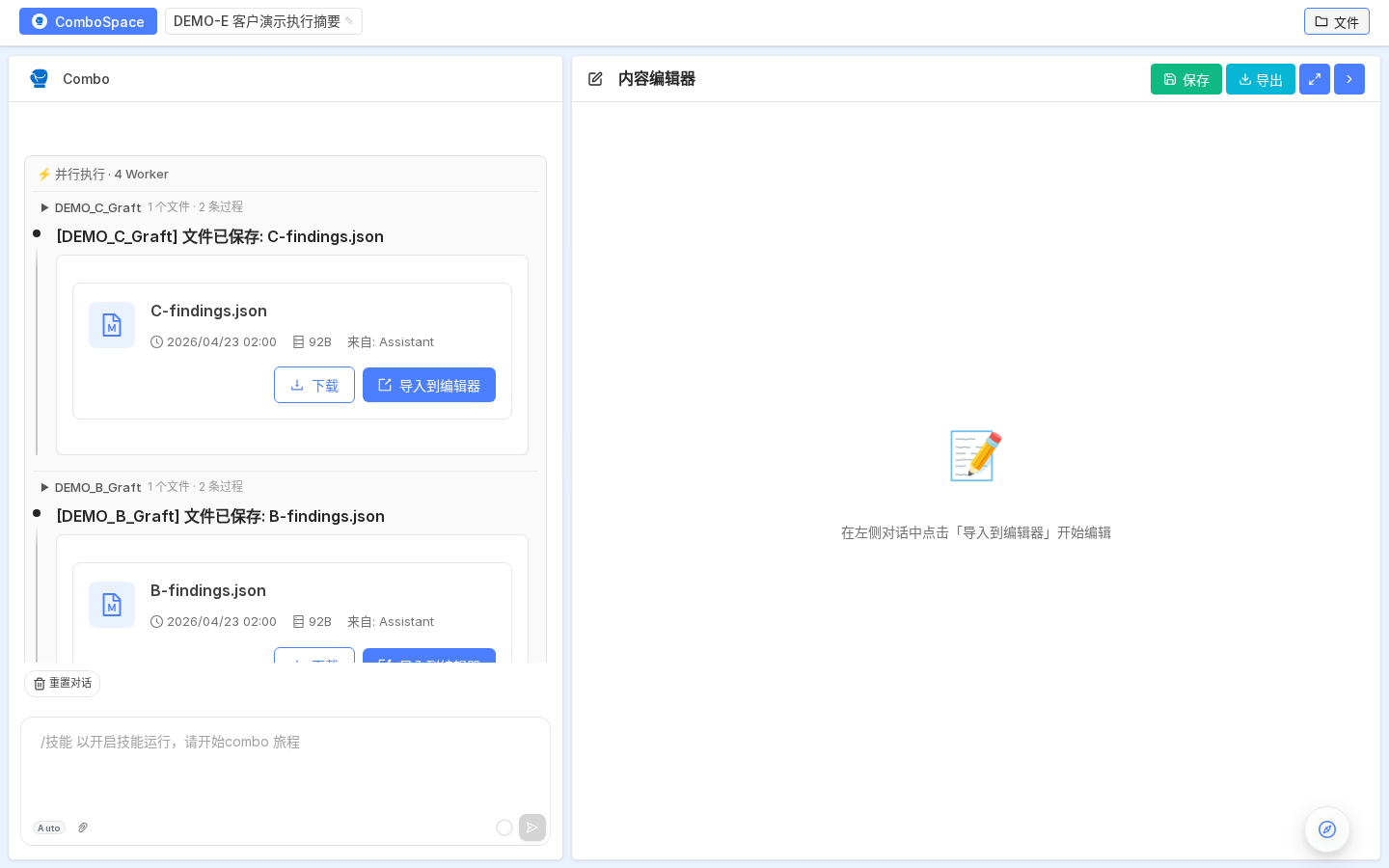
Each Graft worker (DEMO_C_Graft, DEMO_B_Graft, DEMO_A_Graft, DEMO_D_Graft) reads its upstream session independently, saves slim artifacts such as A-findings.json / B-findings.json / C-findings.json, then the main Agent in this session aggregates them.
Aggregated output: OUTPUT_JSON records graft sources and final artifacts
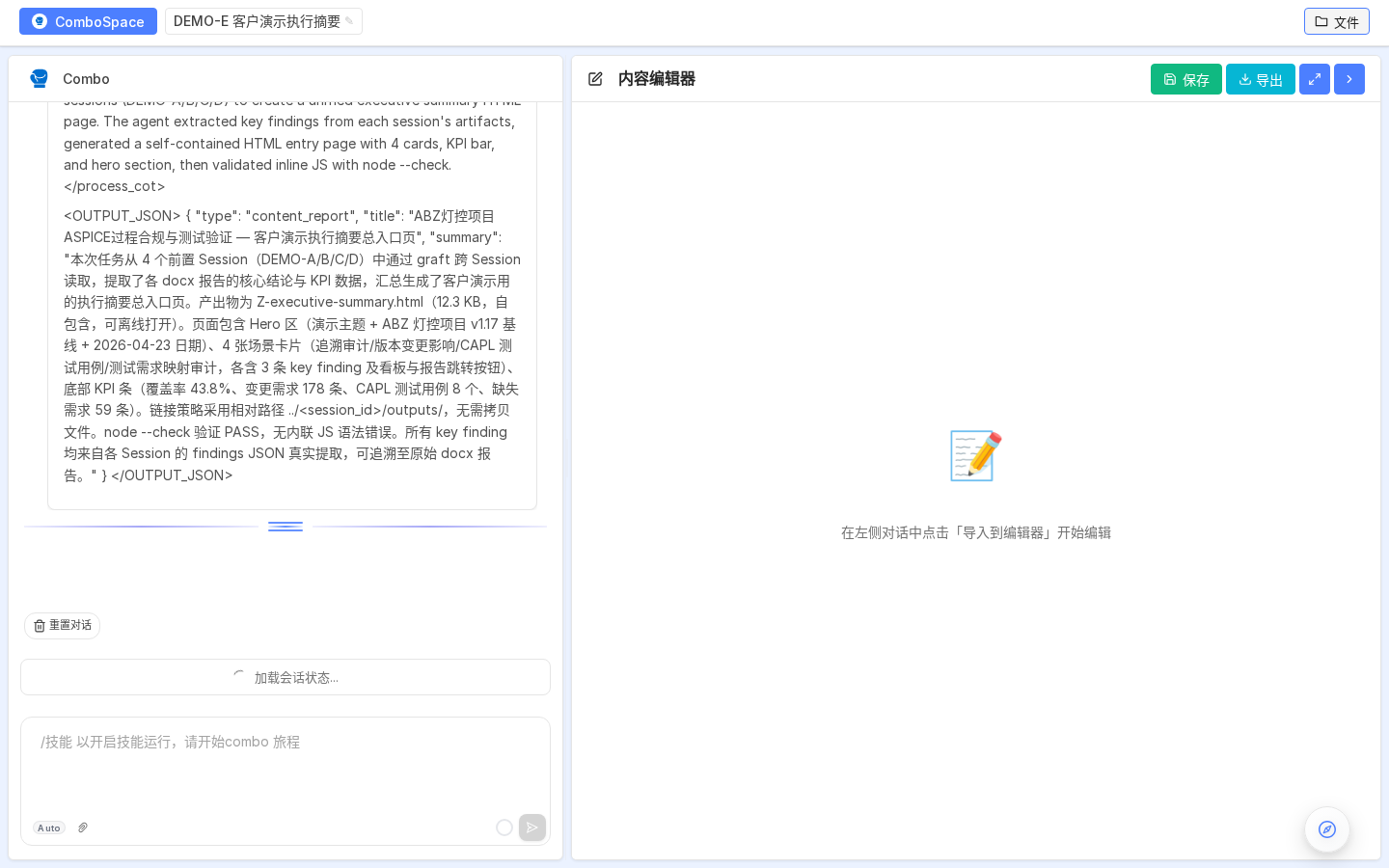
The Agent’s OUTPUT_JSON states in natural language that “this task grafted across four prior sessions (DEMO-A/B/C/D) …”—traceable provenance is a core property of Graft.
Related docs
- Session
- Memory
- Skills
- skills/agentic/graft — cloud builtin (platform Agent)
- skills/coding-agents/graft-comboagent — local (Cursor / Claude Code / Codex)