 Nox-Lumen Mfg
Platform architecture
Architecture overview
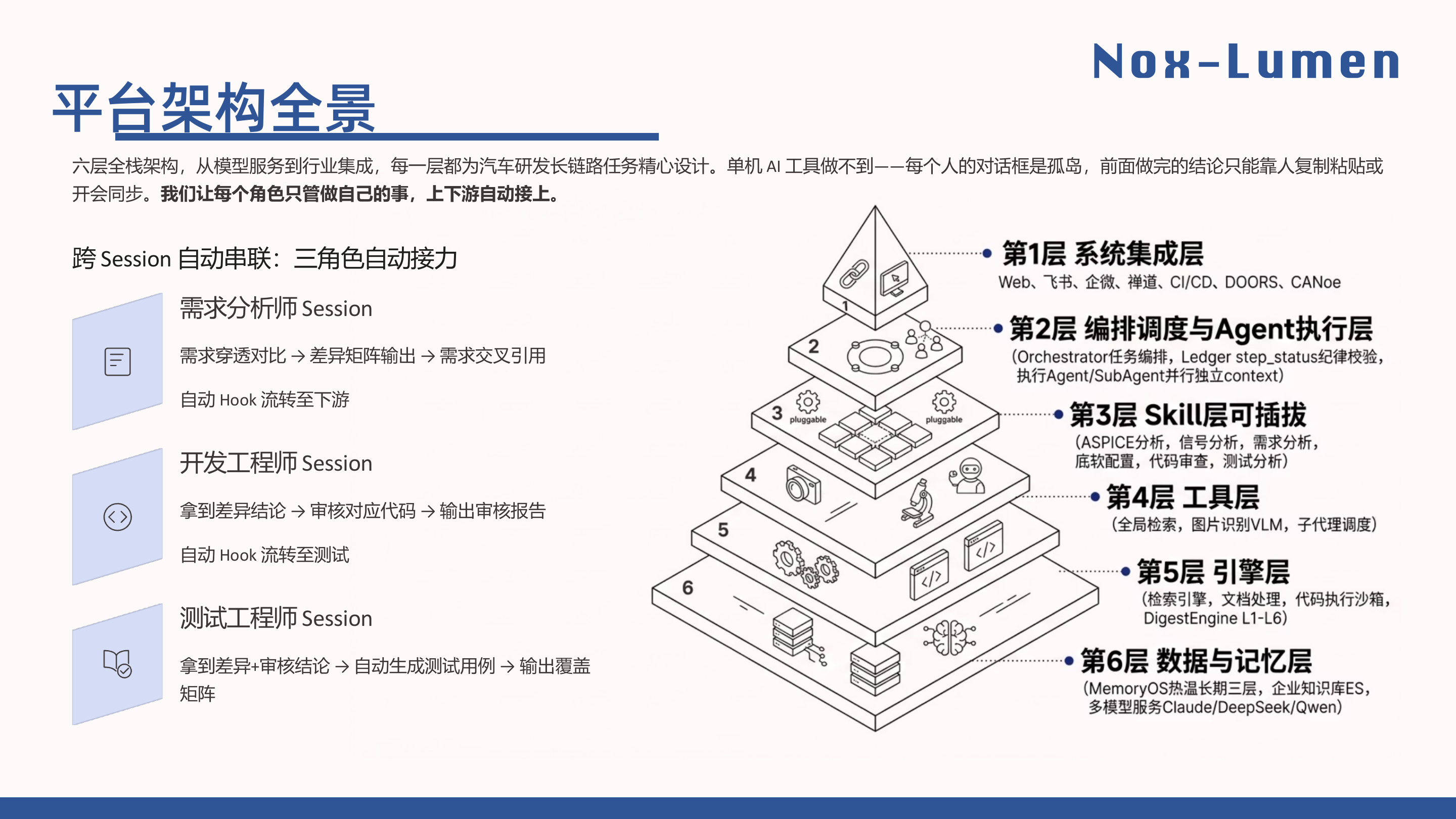
The six-layer stack spans from model services to industry integrations, each tuned for long-horizon tasks. On the left, three roles chain automatically across sessions: requirements analyst → development engineer → test engineer, coordinated by the Hook system.
Layers
Rendering diagram…
Request lifecycle
Rendering diagram…
Distributed execution
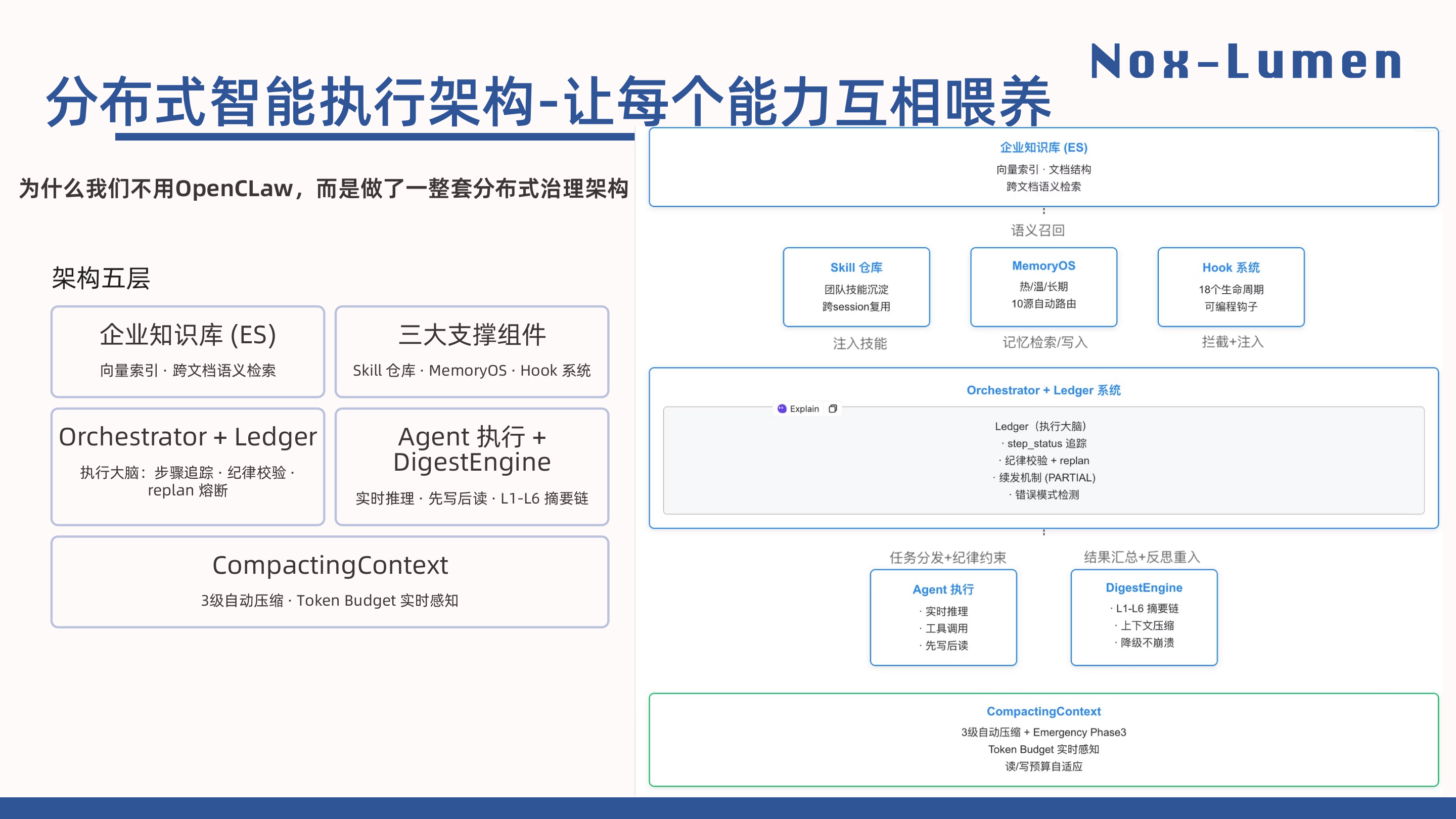
Five components reinforce one another to deliver long chains ordinary agents struggle to complete:
- Orchestrator + Ledger — execution brain: step tracking, discipline checks, replan fuses
- Agent runtime + DigestEngine — live reasoning, write-then-read, L1–L6 digest chain
- CompactingContext — three-level auto compression with live token budget awareness
- Skill repository / MemoryOS / Hooks — three supporting pillars
- Enterprise knowledge base (ES) — vector index + cross-document semantic search
Full six-layer stack
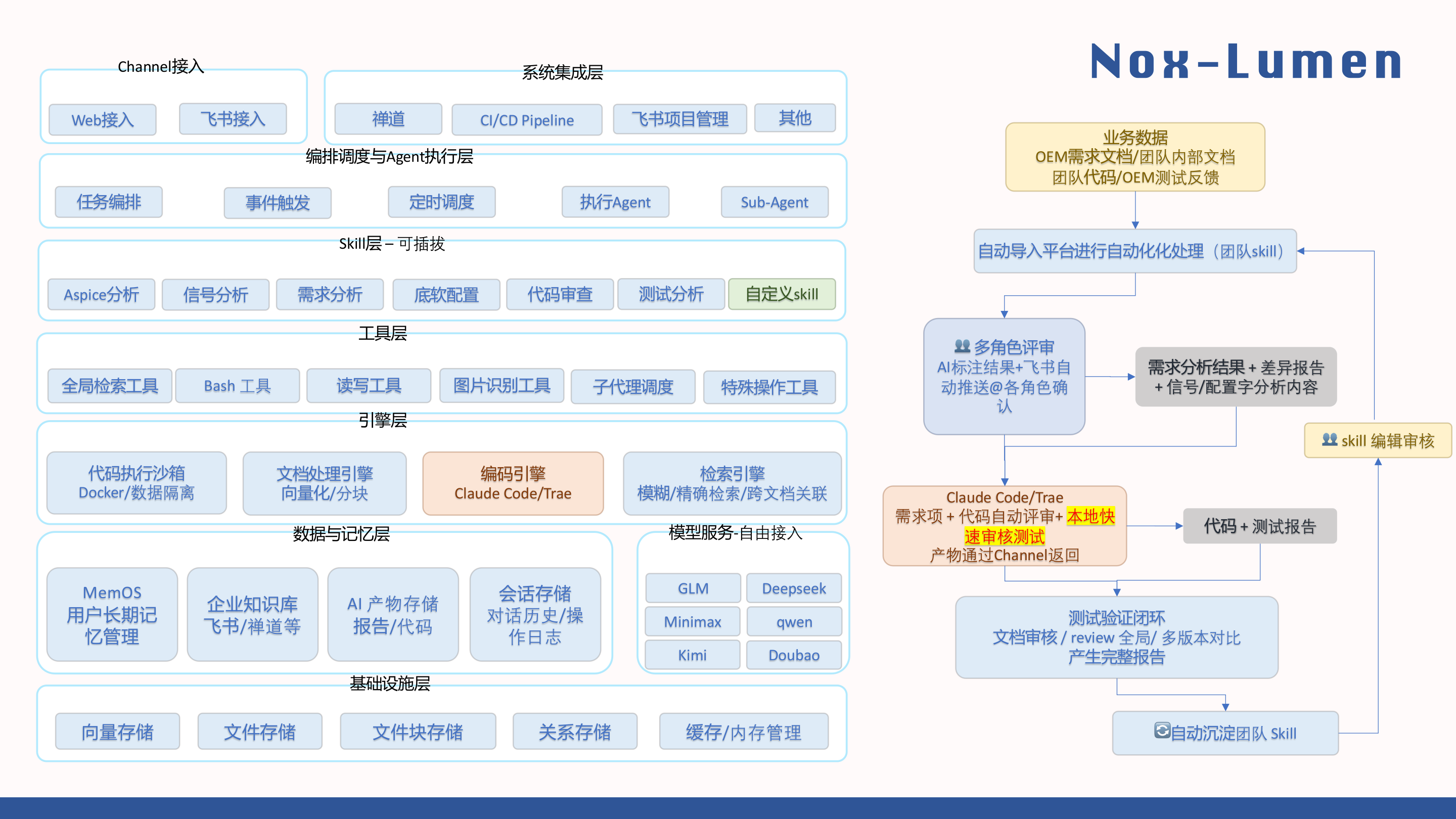
From channel ingress to infrastructure, each layer is pluggable. Map to core concepts:
- Channel → Channels
- Orchestration & Agent execution → Agents & multi-agent + Event triggers + Cron
- Skill layer → Skills
- Data & memory → Memory + Storage
Enterprise capability benchmark
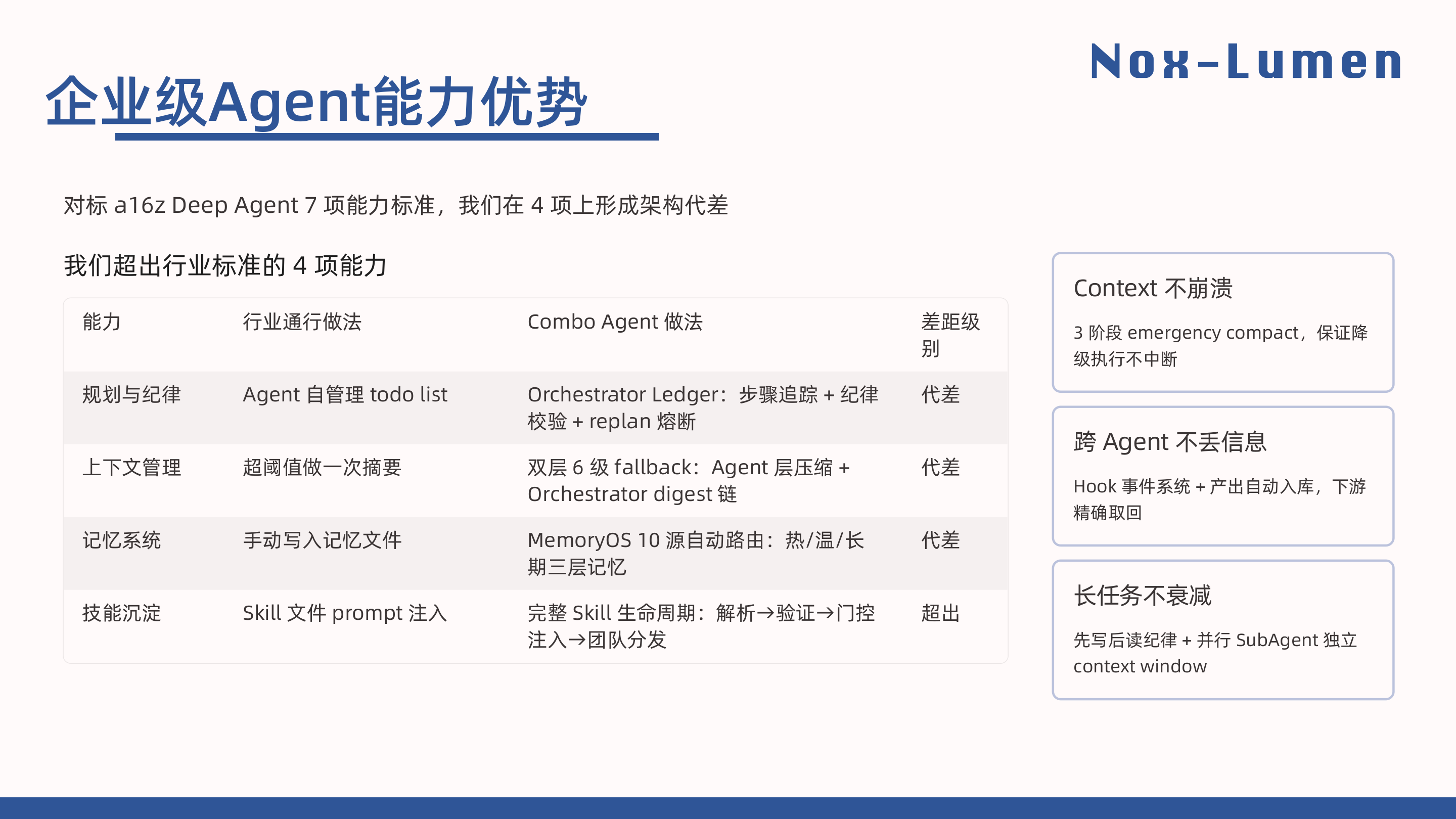
| Capability | Common industry approach | combo agent approach | Delta |
|---|---|---|---|
| Planning & discipline | Agent-managed todo list | Orchestrator Ledger: step tracking + discipline + replan fuse | Step change |
| Context management | Summarize once over a threshold | Dual-layer six-level fallback: Agent compression + Orchestrator digest chain | Step change |
| Memory | Manual memory files | MemoryOS 10-source auto routing: hot / warm / long-term | Step change |
| Skill capture | Skill file prompt injection | Full skill lifecycle: parse → validate → gated inject → team distribution | Beyond |
Design principles
- Skills are capabilities: add domain power by adding Skills, not by rewriting the Agent
- Event-driven: Cron jobs and event triggers are peers; the Agent decides actions from prompts
- Tenant isolation: Storage, Memory, and Skill registration are layered by tenant / user / session
- Model-agnostic: route to Claude, GPT, Gemini, DeepSeek, Qwen, and others via the routing layer