Building industry-specific AI products is hard in two ways: don't rewrite generic capabilities for every project, and don't let industry know-how pollute a shared framework and leak into other customers. combo agent separates these two concerns at the architecture level from day one.
TL;DR
| Problem | Our Answer |
|---|---|
| How does one team ship AI products for three industries simultaneously? | Platform layer (generic) + application layer (industry-specific), one codebase, three variants |
| Platform upgrades — how do they not break industry product stability? | Per-variant unit tests + shared e2e pipeline; platform change → all three variants re-test together |
| How does industry know-how not pollute the platform? | Docs and skills isolated in per-variant subtrees; runtime only loads the current variant's application layer |
| How does customer data not cross tenant boundaries? | Physical tenant isolation; no cross-customer "industry benchmark" training |
The Dilemma of Industry AI Deployment
Two failure patterns we've seen repeatedly:
Type A: Generic AI assistant + industry prompt templates. Result: customers get "ChatGPT with a skin + a pile of system prompts." It can't answer professional questions, terminology is off, and workflows don't fit.
Type B: Build a product from scratch for each industry. Result: the business works, but when moving to the next industry you find yourself rewriting multi-Agent orchestration, context management, memory systems, and skill scheduling all over again.
combo agent's design: generic and industry-specific must be separated at the architecture level, but well-integrated at the product level.
What the Platform Layer Does
The platform layer is combo agent, providing capabilities that are industry-agnostic:
| Capability | Key Design |
|---|---|
| Multi-Agent Task Orchestration | Magentic-One style orchestrator: plan / execute / reflect in three phases |
| Context Management | Long-session window strategy (default 200K, tunable) + intelligent compression + dual-layer memory (STM/LTM) |
| Skill Ecosystem | Hot-pluggable capability units; use community ecosystem (gstack / lark / wecom / docx / xlsx) or write customer-specific ones |
| Session & Team Collaboration | Parallel sessions / region-based editing / one-click session sharing with teammates |
| Multi-tenancy & Channels | Lark / WeCom / Email / Web SDK entry points; physical tenant-level data isolation |
| Code Index Three Tiers | Zero / light / heavy index — choose the depth that matches your use case |
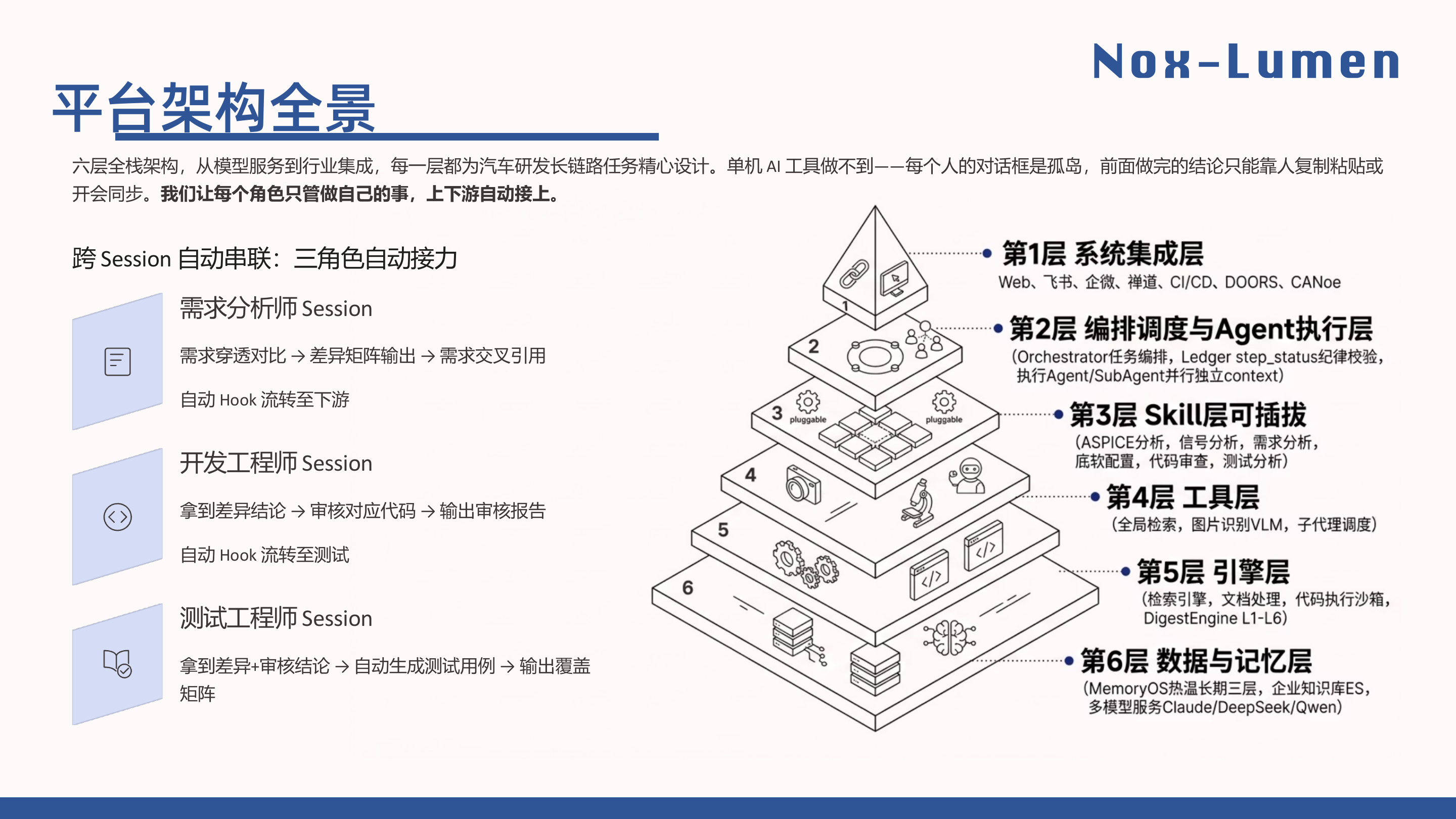
Full platform capabilities: combo agent User Manual.
What the Application Layer Does
Each industry gets one variant, layering industry-specific know-how on top of the platform:
| variant | Industry | Application Layer Contains |
|---|---|---|
| patent / xIPnex | Intellectual Property | Patent-agent-level AI, patent knowledge base, examination guideline rules, specification / claims / drawing templates, novelty-search multi-source prior art, patent-doc-formatter CNIPA-format output |
| auto / Nox-Lumen Auto | Automotive R&D | ASPICE 4.0 engineering loop, MCAL configuration generation, CANoe / dSPACE / NI / ETAS test automation, ISO 26262 / 21434 compliance assistance, ARXML / DBC / A2L multi-standard conversion |
| mfg / Nox-Lumen Mfg | Manufacturing | Automated drawing review, similar-project retrieval, dual-system quotation, Excel V1 template alignment, customer-isolated memory |
The core of the application layer is encapsulating industry workflows and expert rules. For example, automotive's automotive-process-analyzer knows what a broken link in a V-model looks like; patent's patent-agent knows the structural constraints of independent and dependent claims; manufacturing's drawing-review knows how to classify "red/yellow/blue issues" in window engineering projects.
One Codebase, Three Websites
We didn't fork the codebase for each industry. Instead, we use NEXT_PUBLIC_SITE_VARIANT to switch on a single codebase:
- Landing page copy:
messages/{locale}.{variant}.jsonoverlays on top of the basemessages/{locale}.json - Brand config:
config/sites/{patent,auto,mfg}.tscontrols logo / site name / color palette - Docs filtering:
app/source.ts'sVARIANT_HIDEensures each site only sees its own industry's doc subtree - Blog filtering: Each post's frontmatter
variants: ["patent"]is filtered at runtime per variant
Result: xipnex.nox-lumen.com, auto.nox-lumen.com, and mfg.nox-lumen.com — three domains, three brand identities, three doc subsets — but new model releases, new generic Skills, and platform bug fixes are deployed exactly once.
Why This Architecture
Separating generic from industry-specific is better for customers and for us:
- Customers get a product that has been re-calibrated to their industry's terminology, workflows, and compliance language — not "generic AI assistant + customer-configured prompts"
- Upgrading the model or orchestrator benefits all three industries simultaneously; adding a new industry only adds a variant without touching the platform
- Data is strictly tenant-level physically isolated, no cross-customer "industry benchmark" training, customer data sovereignty is non-negotiable
- Platform changes run through a shared CI / shared e2e — regression happens once, all three benefit
Key Platform Capabilities
Code Index Three Tiers
Not "bare LLM reading a diff" — the platform supports selecting index depth by scenario:
| Tier | Best For | Avg Response Time |
|---|---|---|
| Zero index | Ad-hoc review of an outsourced commit, one-off takeover of legacy code | Instant |
| Light index (default) | Daily PR / MR / Gerrit change review | Seconds after a file change |
| Heavy index | Cross-compilation-unit / full-branch / full-repo review, ASPICE compliance audit, SOTIF safety analysis | 10 min ~ hours to initialize |
ASIL-D module: "which downstreams are affected if I change this line?" — heavy index is mandatory. See Code Index Three Tiers.
Graft: Cross-Session Handoff
Each session is an isolated context, but sometimes you need to "relay" — e.g., after an ASPICE traceability analysis, the next session for change impact analysis should directly reuse the previous session's output without re-running everything. Graft makes handoff a first-class capability. See Graft Skill.
bug-import: Turn Historical Bugs into LTM
Import historical issues from Jira / Polarion / internal defect trackers via bug-import, aggregated along four dimensions: module hotspots / cross-module patterns / file hotspots / recurring root causes. Future code reviews that match historical patterns are automatically flagged bug_pattern_match. See bug-import Skill.
Deployment
- Multi-modal entry: Lark / WeCom / Email / Web SDK / HTTP API — same session identity across all channels
- Private deployment: On-premises / intranet / state-encryption compliant — meets OEMs, Tier1s, law firms, and manufacturing enterprises' data sovereignty requirements
- Managed operation: We continue maintaining after go-live; customers don't need to build an AI team (see Engagement Process)
Explore Each Industry in Depth
- Legal: xIPnex Progress · From Disclosure to Patent Draft
- Automotive: Nox-Lumen Auto Progress · ASPICE Engineering Loop Case Study
- Manufacturing: Nox-Lumen Mfg Progress · Window Engineering Customer Case Study
Full platform capability list: combo agent User Manual. All three industry application layers: solutions.
Written by
Nox-Lumen Tech-team
Published
May 14, 2026